
BPP Bioportide™ · product line
BPP Bioportide™ transformation kits for organisms that resist the usual methods
Many organisms are difficult to transform using conventional methods, which often require complex preparation of competent cells, electroporation or conjugation, yet still deliver low transformation efficiencies. Even well-established model organisms such as E. coli can present challenges, particularly when working with large plasmids or high-throughput applications.
BPP Bioportide™ offers a simpler alternative. It binds DNA or RNA and facilitates its delivery into cells without the need for special cell preparation or equipment. This saves time, reduces experimental effort and offers new possibilities for organisms that are difficult to transform using standard methods.
Dedicated kits are available for E. coli, cyanobacteria and ascomycetes. For other organisms, our Exploration Kits allow researchers to screen ten BPP Bioportide™ variants and identify the most suitable one for their target cells.
- 473 colonies from 10 ng of plasmid in Synechococcus elongatus PCC 7942, from a peer-reviewed study.
- From €128 for ten reactions, excluding VAT and shipping.
- 22 nt to more than 10 kb of cargo — DNA or RNA, single- or double-stranded, circular or linear.
Catalogue
Which kit will match your organism?
Three kits are designed for specific groups of organisms or membrane types: Escherichia coli, cyanobacteria and ascomycetes. For other organisms, the exploration kits offer ten BPP Bioportide™ variants selected by cell envelope type. Prices exclude VAT and shipping. The kits are for research use only.
| Kit | Target organisms | List price |
|---|---|---|
| E. coli kit | Escherichia coli and related gram-negative bacteria | from €128 |
| Cyanobacteria kit | Cyanobacteria. Measured in Synechocystis sp. PCC 6803, Synechococcus elongatus PCC 7942 and Synechococcus sp. UTEX 3153. | from €210 |
| Ascomycete kit | Ascomycota, including yeasts and filamentous species | €174 |
| Exploration kits | Four envelope types: archaea, fungi, gram-positive and gram-negative bacteria | from €769 |
Mechanism
How does the BPP Bioportide™ carry DNA into a cell?
A BPP Bioportide™ is a recombinant protein with two functional domains and a molecular weight of roughly 37.5 kDa depending on the variant. One domain binds the nucleic acid, while the other facilitates its passage through the cell envelope. The cell-penetrating domain is designed for a specific envelope composition, which distinguishes the different Bioportide variants. The binding domain interacts with the (deoxy)ribose backbone of the nucleic acid, allowing the complex to form within minutes. Once the BPP Bioportide™ has crossed the membrane, the cargo is released into the cytoplasm and becomes functional. The binding is reversible, allowing the cargo to be released inside the cell through a thermodynamically driven process promoted by competing intracellular nucleic acids.
Cells can be used directly from a culture in mid-log phase, without special preparation. Alternatively, glycerol stocks of cells that were either collected in mid-log phase or prepared using a “competence protocol” can be used. The reaction requires no calcium chloride treatment, no heat shock at 42 °C, no electroporation, no conjugative helper strain and usually no enzymatic digest of the cell wall. For hosts with restriction–modification systems, six approaches to overcome these barriers are described, including their effects on transformation efficiency.
- Cargo length
- 22 nt up to more than 10 kb, handled by the same reagent across that range.
- Compatible nucleic acids
- DNA and RNA, single- or double-stranded, in circular or linear form.
- Ratio to nucleic acid
- Standard kit reactions use a 10:1 Bioportide-to-nucleic-acid mass ratio. A Molar Ratio Calculator is available for planning additional conditions.
- Host range
- Gram-negative and gram-positive bacteria, archaea and fungi, one set of variants per cell envelope.
- Operating range
- Designed to withstand temperatures up to 80 °C, pH above 9.0 and high salt concentration, the reagent is suitable for use with thermophilic, halophilic and mesophilic organisms. It also protects the nucleic acids from chemical degradation.
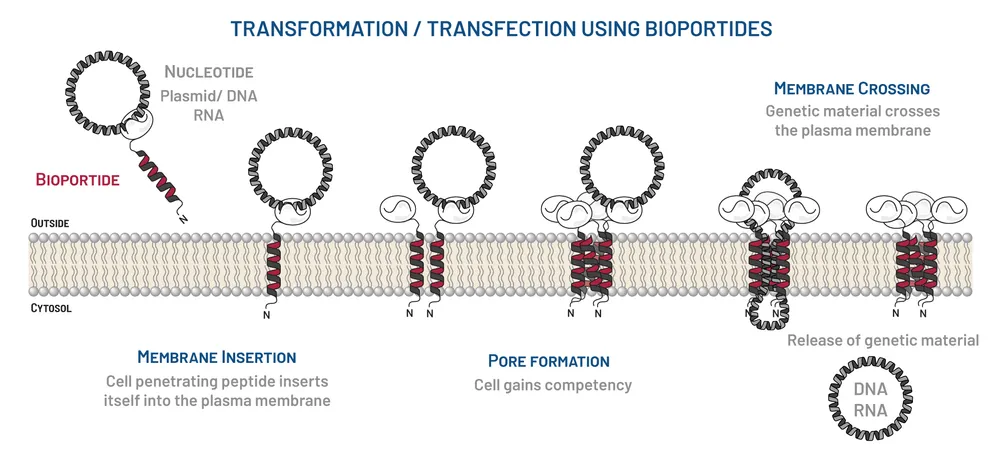
Volumes, incubation times and plating are set out on the protocol pages, together with the seven settings that hold for every organism.
Evidence
Who measured the numbers, and where can you read them?
The 351 colonies come from the BPP Bioportide™ variant in the cyanobacteria kit, the 473 from another variant of the same series.
The cyanobacterial transformation results were obtained at the University of Tübingen. Control experiments with wild-type cells using the same 10 ng of DNA without a BPP Bioportide™ resulted in no colonies. Unlike conventional methods, Bioportide transformation does not require naturally competent cells, conjugative donor strains or electroporation. The cyanobacteria page compares these different approaches. The Escherichia coli transformation efficiency was measured at BPP using the standard plasmid pUC19. This assay is also one of the three quality control tests performed on the Bioportide.
Source
Mondal S, Alford JT, Kutzner C, Forchhammer K, Doello S. BPP Bioportide-mediated (genetic) transformation in cyanobacteria: a rapid and simplified approach for efficient molecular translocation and genome modification Frontiers in Plant Science, 2026. Open access.
doi.org/10.3389/fpls.2026.1812316
Measured in the Forchhammer group, University of Tübingen.
It has revolutionized our ability to transform previously challenging target organisms like Anabaena or Nostoc. The benefits in terms of time savings, reduced DNA usage and improved efficiency are remarkable, opening up new research possibilities.
Microbiology / Organismic Interactions, University of Tübingen
Consultation
Not sure which kit fits your organism?
Tell us about your organism, strain and culture conditions. Our scientists will provide a protocol adapted to your strain, and on request arrange a video call with the research team. The consultation is free of charge.
Write to service@bpp-peptides.com, or find preliminary information on the Documents page.
What to include
- Organism
- Species and strain.
- Culture
- Medium, growth conditions and growth stage at harvest.
- Nucleic acid
- Size, type and amount of the DNA or RNA to deliver.
- So far
- What you have tried and what happened.
Screening
No kit for your organism yet?
Then you choose by cell envelope. An exploration kit holds ten BPP Bioportide™ variants built for one envelope type, so you can try all ten against your organism instead of guessing which one to buy. With your purchase, you are eligible to receive an additional, customised set of ten BPP Bioportide™ variants free of charge, selected by our scientists based on your experimental results and confidential feedback.
Pick the kit for your organism
If none of the seven kits is suitable for your organism, send us details of your strain and nucleic acid construct. Our team will advise you on available experimental data and recommend which Bioportide variant to start with.