
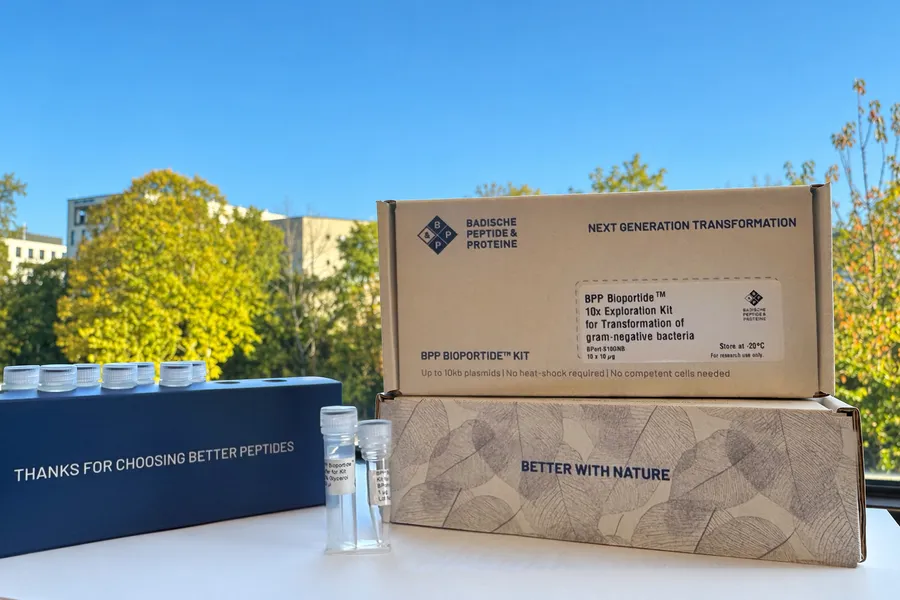
For research use only.
BPP Bioportide™ · exploration kit
Exploration kits for organisms that resist transformation with external DNA and RNA
A BPP Bioportide™ Exploration Kit contains ten variants for one type of cell envelope, so select the kit based on your organism's cell envelope type. Every vial contains 10 µg of lyophilised Bioportide, sufficient for ten reactions, and ten vials make 100 reactions per box. Positive results exist across bacteria, cyanobacteria, fungi and plants: Escherichia coli, Synechocystis and Synechococcus, hydrogen-oxidising bacteria, Sordaria and tobacco.
- Ten variants, numbered one to ten, differing in the cell-penetrating domain: number one is designed as the most suitable for the envelope type.
- €7.69 per attempt at the €769 list price, against €12.80 per reaction for the smallest single-organism kit.
- Designed to withstand temperatures up to 80 °C, pH above 9.0 and high salt concentration, suitable for thermophilic, halophilic and mesophilic organisms.
List price
from €769
100 reactions per kit. Excludes VAT and shipping.
Order from BPPShips from Germany within 3 working days.
Through our distributor
Biomol
One-click ordering with the catalogue numbers in the table below.
Order via BiomolFor institutions with a Biomol account.
Selection
Choose by cell envelope
Choose by the envelope of your organism: archaeon, fungus, gram-positive or gram-negative. The cationic residues of the cell-penetrating moiety interact with the negatively charged domains of the cell wall and the membrane; in gram-positive bacteria the high curvature can promote pore formation, and in fungi endocytosis may take up the Bioportide–nucleic acid complex more readily. The ten variants in a box differ in exactly that domain, each designed for one envelope composition.
There are four exploration kits, one per envelope type, 100 reactions each. Each catalogue number links to the corresponding kit at Biomol. List prices, excluding VAT and shipping.
| Cell envelope | Exploration kit | Biomol catalogue number | List price | Per reaction |
|---|---|---|---|---|
| S-layer or pseudomurein, ether-linked membrane | Archaea | BPP-BPort-S10A | €1,050 | €10.50 |
| Chitin and glucan cell wall | Fungi | BPP-BPort-S10F | €769 | €7.69 |
| Thick peptidoglycan layer, no outer membrane | Gram-positive bacteria | BPP-BPort-S10GPB | €769 | €7.69 |
| Outer membrane with lipopolysaccharide, thin peptidoglycan | Gram-negative bacteria | BPP-BPort-S10GNB | €769 | €7.69 |
Every box contains ten numbered vials of BPP Bioportide™ and one vial of buffer, enough for 100 reactions. Starting protocols are written for methanogens in Whitman medium, fungi in YPAD and gram-positive bacteria in BHI. Each names where in your own workflow the complex is added to the cells.
Ten further variants free of charge. The Exploration Kits include a special offer: Each kit contains ten different BPP Bioportide™ variants. With your purchase, you are eligible to receive an additional, customised set of ten BPP Bioportide™ variants free of charge, selected by our scientists based on your experimental results and confidential feedback.
Screening
Why screen with variants
The BPP Bioportide™ Exploration Kit allows you to test ten Bioportide variants under the same experimental conditions. All variants use the same buffer and incubation protocol. They differ only in their cell-penetrating domain, allowing you to directly compare their performance using one protocol and one set of controls.
Keep in mind that the cell-penetrating domain may have a cytotoxic effect on your target (micro)organism. While optimal BPP Bioportide™ concentrations are already established for organisms such as Escherichia coli, they may need to be determined for other organisms. For this reason, each vial in the exploration kit contains ten times more freeze-dried Bioportide than in the standard E. coli kit. This allows you to test for cytotoxicity by performing a dilution series. Detailed instructions are in the kit manual and under Documents.
Specification
What the kit does
- Reactions per kit
- 100 per kit, ten per vial. One reaction yields 1 ml of treated culture for plating.
- Working solution
- Reconstituting one vial in 10 µl of buffer gives a working solution of 1,000 ng/µl.
- Nucleic acid per reaction
- 100 ng (1 µl at 100 ng/µl), mixed with 1000 ng of BPP Bioportide™ (1 µl of working solution).
- Ratio to nucleic acid
- The general protocol starts with 10 parts Bioportide to 1 part nucleic acid by weight, for any construct.
- Compatible nucleic acids
- DNA and RNA, single- or double-stranded, circular or linear, from 22 nt up to more than 10 kb.
- Cells
- Early to mid-log phase, OD600 0.4 to 0.6 for bacteria. Cells are harvested at low speed and resuspended in 100 µl to 2 ml of medium or buffer; 50 µl go into the reaction. Gram-positive bacteria take the complex directly in 1 ml of culture.
- Incubation and recovery
- Bioportide–nucleic acid complex formation takes 10 minutes at room temperature, followed by 10 minutes of cell incubation at a temperature the cells tolerate. Recovery follows addition of 950 µl of medium, by your usual protocol. Test a shorter recovery as well.
- Operating range
- Designed to withstand temperatures up to 80 °C, pH above 9.0 and high salt concentration, the reagent is suitable for use with thermophilic, halophilic and mesophilic organisms. It also protects the nucleic acids from chemical degradation.
- Storage
- Lyophilised BPP Bioportide™ and buffer: −20 °C or −80 °C for long-term storage. Dissolved working solution: −20 °C.
- Shipping
- Room temperature, +20 °C.
- Storage as delivered
- Lyophilised powder, chemically stable. Stable for at least 12 weeks at 25 °C.
- Shelf life
- More than three years at −80 °C.
Consultation
Ask the scientists who developed the Bioportide
Tell us about your organism, strain and culture conditions. Our scientists will provide a protocol adapted to your strain, and on request arrange a video call with the research team. The consultation is free of charge.
We can also advise on BPP Bioportide™ concentration ranges already tested in related species.
What to include
- Organism
- Species and strain.
- Culture
- Medium, growth conditions and growth stage at harvest.
- Nucleic acid
- Size, type and amount of the DNA or RNA to deliver.
- So far
- What you have tried and what happened.
Contents
Kit contents and documents
What ships with the kit
- 10 × BPP Bioportide™, lyophilised, 10 µg each, numbered one to ten — ten reactions per vial. Each vial also contains HEPES and arginine as buffer material.
- 1 × BPP Bioportide™ Buffer, a separate vial with 500 µl of sterile 50 % glycerol, which dissolves the lyophilisate into the working solution.
You supply the medium and the selective plates for your organism. BPP Bioportide™ is not classified as a hazardous substance or mixture under Regulation (EC) No 1272/2008; wear gloves and eye protection, and the manual and the safety data sheet set out the rest.
Documents
- The workflow for other organisms, with example protocols for fungi, gram-positive bacteria and archaea
- Manual for the exploration kits, eight pages, PDF
- Safety data sheet in English (ten pages) and German (eleven pages), PDF
- The dilution series for the 10 µg stocks, for fixing the Bioportide concentration on a new organism, also as a PDF
- FAQ and troubleshooting, three pages, PDF
Questions
Before you order
Exploration kit for fungi or fungal transformation kit?
The Fungal Transformation Kit holds one BPP Bioportide™ for Ascomycota, for ten reactions at €174. Choose it when your organism is an ascomycete and you want to start with the BPP Bioportide™ made for that group. The exploration kit for fungi holds ten variants, 100 reactions at €769, and the whole set can be screened on any fungus: one outside Ascomycota, or an ascomycete whose plates stay empty with the first Bioportide. The kit also holds the Bioportide of the Fungal Transformation Kit.
Which of the ten variants do I start with?
Number one. The vials are numbered one to ten, and number one is designed as the most suitable variant for the organisms of its kit. Start there at the standard amount and run a methylation-adapted control plasmid beside it, so that a blank plate can be interpreted. To cover more ground at once, test all ten side by side: one reaction per variant uses ten of the 100 reactions and one set of controls, and the plates show which variant works best on your strain. See the workflow and the settings that apply to every run.
One variant worked. How do I get more of it?
Each vial contains enough BPP Bioportide™ for ten reactions, so you can continue experimenting with a promising variant after the initial screening. If you need more, you can reorder the exploration kit or write to service@bpp-peptides.com with its number and your organism. For some organisms we already offer dedicated kits with a lower entry price: Escherichia coli and related gram-negative bacteria at €128, ascomycetes at €174, and cyanobacteria at €210, each for ten reactions. The E. coli and cyanobacteria kits also come in 30, 50 and 100-reaction packs.
How do I cite the kit in a methods section?
Give the kit name, the catalogue number and the manufacturer, in this form:BPP Bioportide™ 10x Exploration Kit for gram-negative bacteria (BPort-S10GNB, Better Peptides Platform GmbH, Mannheim, Germany).The exploration kits come in four editions, so name the one you used, with its catalogue number.
What do I do about escape colonies, or none at all?
To check an escape colony, grow it in selective broth and confirm the plasmid by plasmid prep with restriction mapping or by a site-directed PCR. Whether the plate shows escape colonies or none at all, the dilution series tests several amounts of Bioportide in one round. Cytotoxicity depends on the concentration and the penetrating domain in use: in a collaboration with BioMedX, mammalian cells tolerated 0.6 to 3 µg per ml, and gram-positive bacteria tolerate less. You can dilute one vial to four working concentrations, 1000 down to 1 ng/µl, with the nucleic acid diluted in step to keep the ratio constant. The dilution series describes how to prepare the four tubes. If the control plasmid gives colonies and yours does not, the Bioportide works on your strain and the plasmid is the open question; if neither gives colonies, test another of the ten Bioportides.
How long does an order take?
BPP ships orders for the BPP Bioportide™ kits from Germany within three working days. The kits travel at room temperature, +20 °C, so no dry ice or cold chain shipping is required.
Order
Order an exploration kit
Order with the form below, or from the distributor Biomol under the catalogue number of your kit. Both routes have the same list price. The kits are for research use only.
Order sent
Your order has gone to Better Peptides Platform with these details.
To change or add something, e-mail sales@bpp-peptides.com.