
Technology
How carrier fusion expression makes peptides of 15 to 250 amino acids
Better Peptides Platform produces every peptide as part of a larger carrier fusion protein consisting of three domains: a carrier domain that aggregates the protein into inclusion bodies and binds to the purification matrix, a release domain that cleaves off the target peptide in response to a pH shift, and the payload, which is your target sequence of 15 to 250 amino acids. Inside the host cell the payload remains part of a larger protein rather than a free short peptide, protecting it from degradation by cellular proteases. The process requires no dimethylformamide, acetonitrile or dichloromethane.
Why are short peptides degraded inside the cell?
Bacterial cells continuously recycle short unfolded polypeptide chains. In Escherichia coli the ATP-dependent proteases Lon and Clp account for 70 to 80 % of energy-dependent cytoplasmic protein degradation, which itself represents more than 90 % of total protein degradation[1]. Both bind their substrates at exposed unstructured segments and at accessible termini, which are usually buried in properly folded native proteins[2]. Recombinant peptides of 30–40 amino acids often have no stable fold and two exposed termini, which is why heterologous expression of a bare peptide becomes difficult below roughly 50 amino acids.
Fusing the peptide to a larger carrier protein helps protect it from degradation. Within the fusion protein, the payload is a segment of a folded protein, less accessible to cellular proteases[3]. Carrier proteins can serve different purposes: improving solubility, inducing inclusion body formation or enabling self-cleavage[4]. The carrier domains at BPP belong to the second class.
What do the three domains of the fusion protein do?
Each domain performs a task that would otherwise require a separate reagent or purification step: capture, protection and release. The technology and its associated domains are patented by BPP.
- Carrier & Binding (CB)
- Aggregates the fusion protein into inclusion bodies in bacterial cells, and binds to a polysaccharide-based purification matrix. Purification is performed by chromatography, without hazardous solvent.
- Smart Release (SR)
- A pH-sensitive autoproteolytic domain that releases the target peptide following a pH shift, producing authentic termini without process-related amino acid residues and without the side reactions of solid-phase chemistry.
- Payload (P)
- Target peptide sequence, linear or cyclic, 15 to 250 amino acids.
The release domain determines the peptide's N-terminus. In most fusion systems a protease or a chemical cleavage step is required, followed by removal of the cleavage reagent. The Smart Release domain is activated by a pH shift, eliminating the need to add and subsequently remove a separate protease.
What happens between the sequence and the purified peptide?
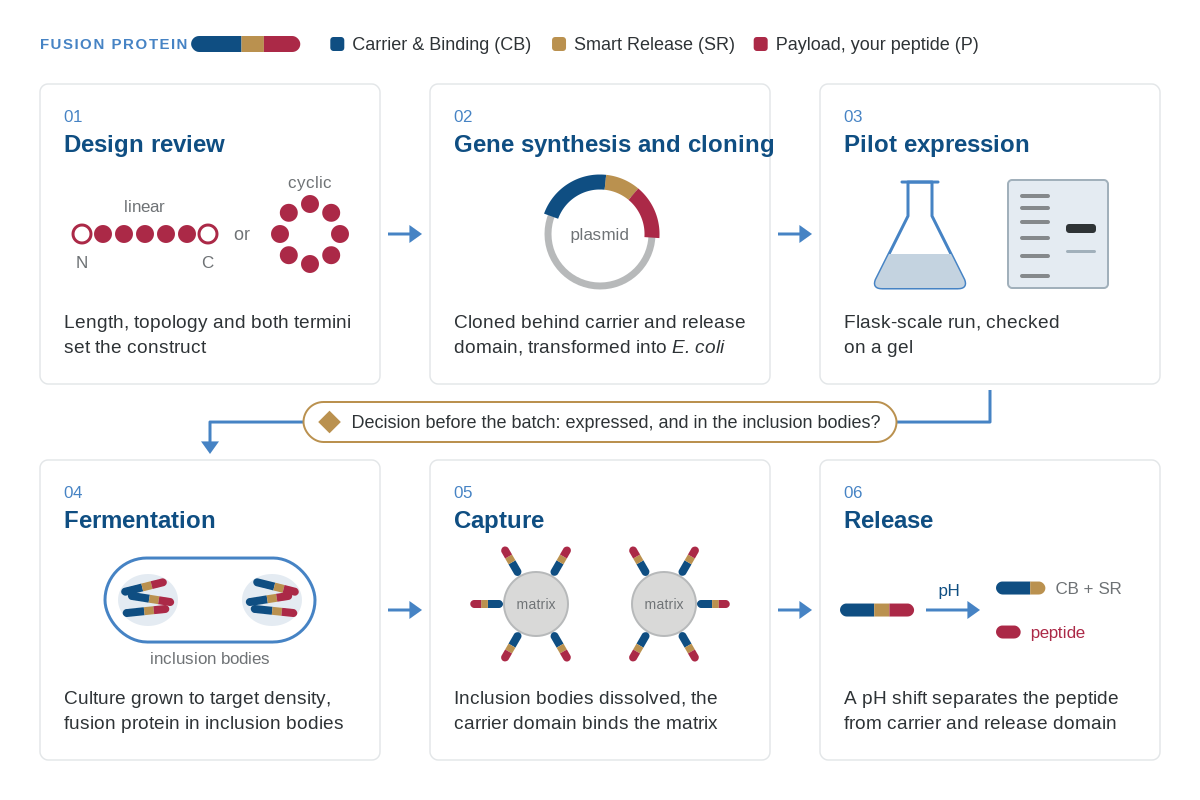
- Design review. Length, topology and the amino acids at both termini determine the junction to the release domain and whether a linear or cyclic construct is required.
- Gene synthesis and cloning. The DNA sequence encoding the target peptide is synthesised, cloned behind carrier and release domain, and transformed into the E. coli production strain.
- Pilot expression. Small-scale expression and gel analysis show whether the fusion protein is produced and accumulates in the inclusion body fraction. This is the decision point before the batch production.
- Fermentation. The culture is grown to the target density and the fusion protein accumulates in inclusion bodies.
- Capture. Cells are disrupted, the inclusion bodies recovered and dissolved, and the carrier domain binds to the purification matrix.
- Release. A shift in pH activates the release domain and the carrier is separated from the target peptide.
The construct design concentrates on the payload segment and the junction around it. BPP works with different carrier domains.
Which impurities of solid-phase synthesis cannot arise here?
Three impurity classes associated with solid-phase peptide synthesis (SPPS) are avoided in this process: racemisation during Fmoc removal, protecting-group adducts, and trifluoroacetate counter-ions carried over from cleavage and preparative chromatography[5]. The target peptide is produced by ribosomal synthesis using L-amino acids, without protecting groups, Fmoc removal or trifluoroacetic acid.
Which sequences fit the route?
Linear and cyclic peptides of 15 to 250 amino acids. Cyclisation uses a derivative of a split intein mechanism, built into the carrier fusion construct and requires no separate chemical step.
The release step also depends on the sequence, and the design review and the pilot expression help establish suitable conditions before a batch production is planned. The amino acid immediately following the cleavage site is particularly important, so please send the residues at both termini when submitting your sequence.
Two peptide properties may require adjustments to the construct, so name them in the enquiry: known activity against a bacterial host, and a disulfide pattern.
Include this information when you write to us.
References
- Maurizi MR (1992). Proteases and protein degradation in Escherichia coli. Experientia 48(2), 178–201. doi.org/10.1007/BF01923511
- Sauer RT, Baker TA (2011). AAA+ proteases: ATP-fueled machines of protein destruction. Annual Review of Biochemistry 80, 587–612. doi.org/10.1146/annurev-biochem-060408-172623
- Li Y (2011). Recombinant production of antimicrobial peptides in Escherichia coli: a review. Protein Expression and Purification 80(2), 260–267. doi.org/10.1016/j.pep.2011.08.001
- Li Y (2009). Carrier proteins for fusion expression of antimicrobial peptides in Escherichia coli. Biotechnology and Applied Biochemistry 54(1), 1–9. doi.org/10.1042/BA20090087
- D'Hondt M, Bracke N, Taevernier L, et al. (2014). Related impurities in peptide medicines. Journal of Pharmaceutical and Biomedical Analysis 101, 2–30. doi.org/10.1016/j.jpba.2014.06.012