
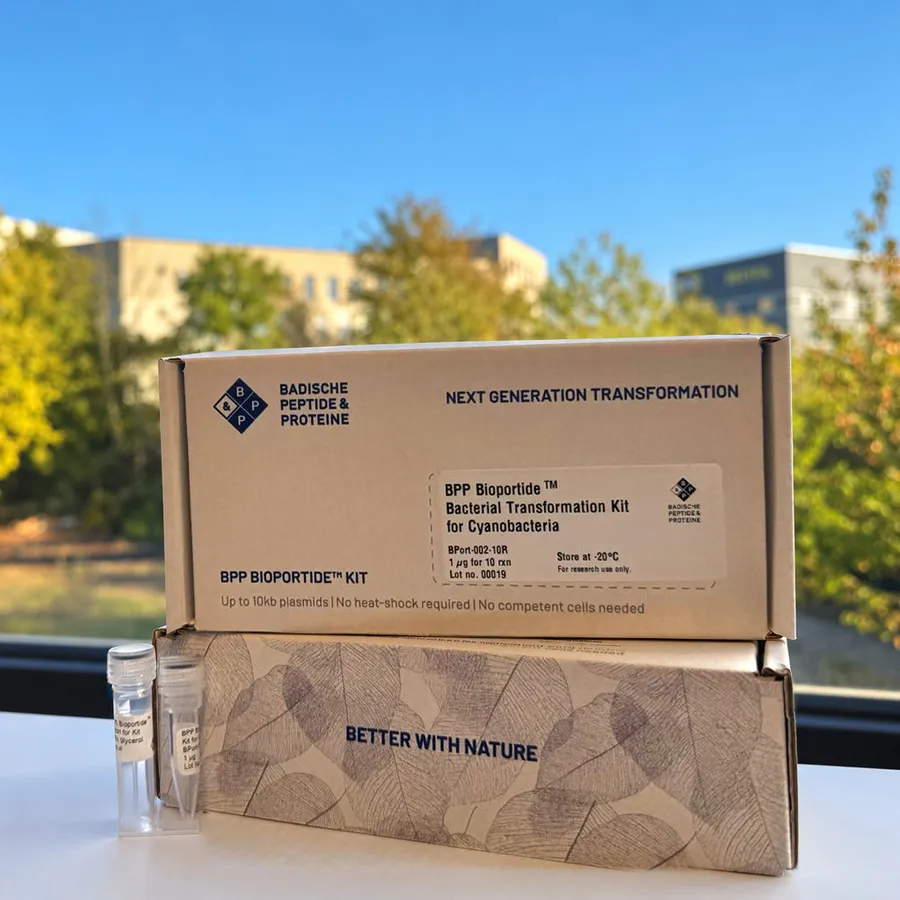
For research use only.
BPP Bioportide™ · transformation kit
Cyanobacteria transformation kit
The BPP Bioportide™ Cyanobacteria Transformation Kit brings nucleic acids into planktonic cyanobacteria that were never made competent. The BPP Bioportide™, a recombinant protein with a cell-penetrating domain, binds the nucleic acid and carries it across the cyanobacterial envelope. BPP Bioportides™ enable cyanobacterial transformation without the need for tedious conjugation or calcium- and electrocompetence protocols. You harvest the culture at OD750 0.4 to 0.6 and concentrate it 25-fold; you need no competent cells, no electroporator and no conjugative helper strain. Ten reactions; from dissolving the vial to the start of recovery takes 40 minutes. Transformation results are supported by a peer-reviewed study.
- 351 and 473 colonies from 10 ng of plasmid DNA after 6 hours of recovery, measured in Synechocystis sp. PCC 6803 and Synechococcus elongatus PCC 7942.
- 10 ng of plasmid DNA per reaction. Without the BPP Bioportide™, the same 10 ng gives no colonies at all.
List price
from €210
10 reactions per kit. Excludes VAT and shipping.
Order from BPPShips from Germany within 3 working days.
Through our distributor
Biomol
Catalogue number BPP-BPort-002-10R, one-click ordering.
Open at Biomol(opens on another site)Use this route if your institution already has an account with Biomol.
Evidence
Colonies from 10 ng of plasmid DNA
The results show 351 colonies for Synechocystis and 473 for Synechococcus elongatus, using 10 ng of circular integrative plasmid DNA and 6 hours of recovery. After 1 hour of recovery, 199 and 325 colonies were obtained, respectively. In comparison, published natural-transformation protocols for these strains typically require 0.5 to 1 µg of DNA per reaction, at concentrations of up to 20 µg/ml. The 351 colonies in Synechocystis come from the BPP Bioportide™ variant in the kit; the 473 in Synechococcus elongatus come from another variant of the same series.
The study tested three unicellular cyanobacterial strains with integrative DNA: plasmids in Synechocystis and Synechococcus elongatus, and a linear knockout cassette in Synechococcus sp. UTEX 3153, which gave 89 colonies after 1 hour of recovery and 36 after 6 hours. Due to genome polyploidy, several rounds of selection may be required to achieve complete segregation. The authors recommend avoiding restriction sites recognised by host enzymes or preparing the plasmid DNA in a methylation-competent E. coli strain.
Source
Mondal S, Alford JT, Kutzner C, Forchhammer K, Doello S. BPP Bioportide-mediated (genetic) transformation in cyanobacteria: a rapid and simplified approach for efficient molecular translocation and genome modification Frontiers in Plant Science, 22 April 2026. Open access.
doi.org/10.3389/fpls.2026.1812316
Measured in the Forchhammer group, University of Tübingen.
It has revolutionized our ability to transform previously challenging target organisms like Anabaena or Nostoc. The benefits in terms of time savings, reduced DNA usage and improved efficiency are remarkable, opening up new research possibilities.
Microbiology / Organismic Interactions, University of Tübingen
Specification
What the kit does
- Target organisms
- Cyanobacteria. Measured in Synechocystis sp. PCC 6803, Synechococcus elongatus PCC 7942 and Synechococcus sp. UTEX 3153.
- Compatible nucleic acids
- DNA and RNA, single- or double-stranded, linear or circular, 22 nt to over 10 kb. In cyanobacteria the measured case is integrative plasmid DNA.
- Plasmid size
- Constructs from 22 nt to over 10 kb can be carried. In Synechocystis, a 6 kbp linear integrative plasmid gave about 300 CFU at 10 ng.
- Nucleic acid per reaction
- 10 ng of nucleic acid mixed with 100 ng of BPP Bioportide™ (1 µl of working solution), maintaining a 10:1 mass ratio in the standard kit reaction.
- Reaction volume
- 52 µl per reaction: 50 µl of concentrated culture plus 2 µl of BPP Bioportide™-DNA complex. The 50 ml culture is harvested at OD750 0.4 to 0.6 and resuspended in 2 ml. After incubation, 950 µl of medium is added, giving about 1 ml for recovery and plating.
- Incubation and recovery
- 10 minutes of incubation at room temperature, then 60 minutes in BG 11 or your usual medium under continuous shaking and illumination of 10 µmol photons m⁻² s⁻¹ (PAR). Cells are then plated on a membrane, incubated for 24 hours without antibiotics and transferred to selective medium. Colonies appear after approximately 7 to 10 days.
- Reactions per kit
- 10 reactions — one vial holding 1 µg of lyophilised Bioportide, dissolved in 10 µl of buffer. Also as 30, 50 and 100 reactions, at €630, €989 and €1,845.
- Storage
- Lyophilised Bioportide and buffer: −20 °C or −80 °C for long-term storage. Dissolved working solution: −20 °C.
- Shipping
- Room temperature, +20 °C.
- Storage as delivered
- Lyophilised powder, chemically stable. Stable for at least 12 weeks at 25 °C.
- Shelf life
- More than three years at −80 °C.
Consultation
Ask the scientists who developed the Bioportide
Tell us about your organism, strain and culture conditions. Our scientists will provide a protocol adapted to your strain, and on request arrange a video call with the research team. The consultation is free of charge.
What to include
- Organism
- Species and strain.
- Culture
- Medium, growth conditions and growth stage at harvest.
- Nucleic acid
- Size, type and amount of the DNA or RNA to deliver.
- So far
- What you have tried and what happened.
Contents
Kit contents and documents
What ships with the kit
- 1 × BPP Bioportide™, lyophilised, 1 µg for ten reactions. The vial also contains HEPES and arginine as buffer material.
- 1 × BPP Bioportide™ Buffer, a second vial with 500 µl of sterile 50 % glycerol, which dissolves the lyophilisate into the working solution.
- 1 × printed one-page protocol for the bench.
You supply a culture at OD750 0.4 to 0.6, BG-11 plates with the appropriate selection antibiotic, and illumination during the recovery hour. BPP Bioportide™ is not classified as a hazardous substance or mixture under Regulation (EC) No 1272/2008; wear gloves and eye protection, and the manual and the safety data sheet set out the rest.
Documents
- The protocol for cyanobacteria, step by step with every volume and time
- Manual for the cyanobacteria kit, four pages, PDF
- Safety data sheet in English (ten pages) and German (eleven pages), PDF
- FAQ and troubleshooting, three pages, PDF
- The one-page protocol, PDF.
Questions
Before you order
Which cyanobacterial strains has this been measured in?
Synechocystis sp. PCC 6803, Synechococcus elongatus PCC 7942 and Synechococcus sp. UTEX 3153, all three in a published study. Working with another strain? Write to service@bpp-peptides.com with its name, and BPP answers with what has been measured on that organism.
How do I cite the kit in a methods section?
Give the kit name, the catalogue number and the manufacturer, in this form:BPP Bioportide™ Bacterial Transformation Kit for Cyanobacteria (BPort-002, Better Peptides Platform GmbH, Mannheim, Germany).
Do I have to prepare competent cells?
No. The BPP Bioportide™ carries the DNA through the envelope, so the cells need no treatment beyond harvesting: you take the culture in early to mid-log phase at an optimal OD750 of 0.4 to 0.6, pellet 50 ml and resuspend in 2 ml. There is no heat shock, no chemical treatment of the cell wall, no electroporator and no conjugative helper strain. The entire procedure takes approximately 2 hours, including BPP Bioportide™ preparation, complex formation, cell incubation and recovery.
How large a plasmid can it carry, and how much DNA does one reaction need?
BPP Bioportide™ can deliver nucleic acids from 22 nt to over 10 kb, including single- or double-stranded DNA and RNA in linear or circular form, as shown in other organisms. Each reaction uses 10 ng of DNA mixed with 100 ng of Bioportide (1 µl of working solution), maintaining a 10:1 mass ratio. In Synechocystis, approximately 300 CFU were obtained using 10 ng of a 6 kbp linear integrative plasmid DNA construct.
What if my strain behaves differently from the protocol?
Use the free consultation: our scientists will be happy to adapt the protocol to your strain.
How long does an order take?
BPP ships orders for the BPP Bioportide™ kits from Germany within three working days. The kits travel at room temperature, +20 °C, so no dry ice or cold chain shipping is required.
What if the first plate stays empty?
Give it up to ten days first: cyanobacteria grow slowly, and on BG-11 with antibiotic colonies appeared after 7 to 8 days in the published study. After that, check the recovery medium, as polysaccharides may bind to BPP Bioportides™ and interfere with DNA delivery. If transformation remains unsuccessful, check whether the plasmid methylation pattern is compatible with the host's restriction–modification system.
To exclude viable E. coli cells from the production of the BPP Bioportide™, BPP plated the dissolved BPP Bioportide™ on LB agar with and without kanamycin. Neither plate showed growth, so the vial contains no viable E. coli.
Order
Order from BPP
Order with the form below, or from the distributor Biomol under catalogue number BPP-BPort-002-10R. Both routes have the same list price. The kits are for research use only.
Order sent
Your order has gone to Better Peptides Platform with these details.
To change or add something, e-mail sales@bpp-peptides.com.