
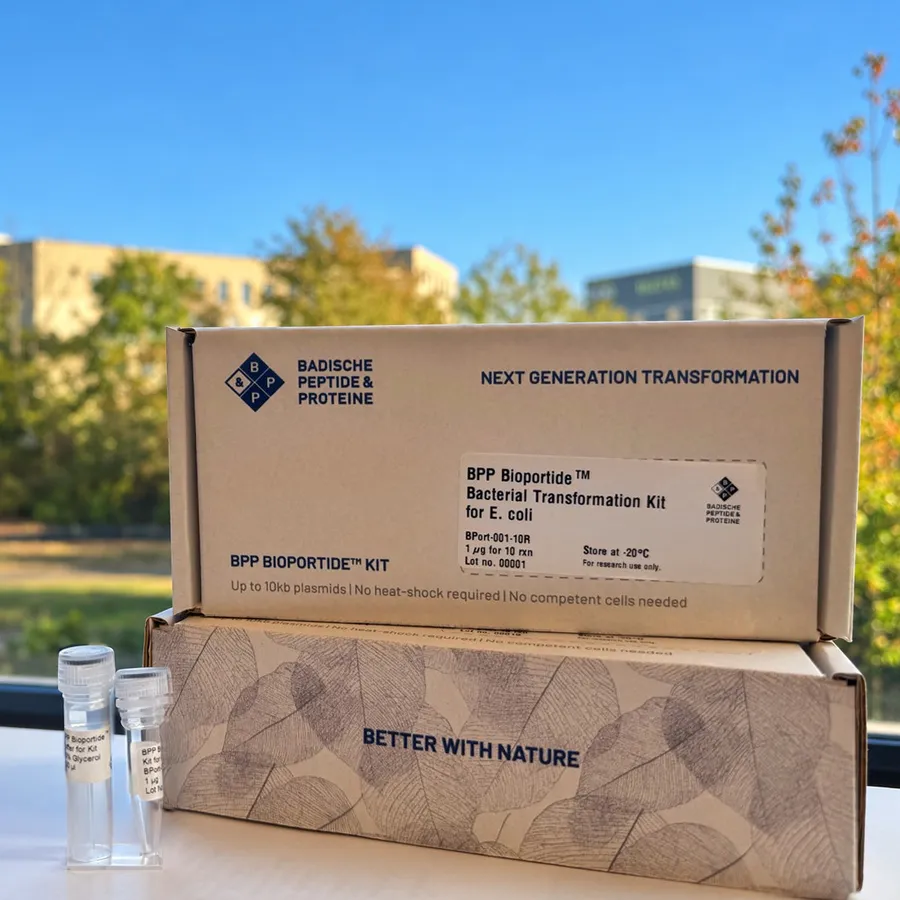
For research use only.
BPP Bioportide™ · transformation kit
E. coli transformation kit
The BPP Bioportide™ Bacterial Transformation Kit for E. coli mediates the delivery of nucleic acids into gram-negative bacteria. The BPP Bioportide™, a recombinant protein with a cell-penetrating domain, binds the nucleic acid and carries it across the cell envelope. BPP Bioportides™ enable bacterial transformation without the need for tedious calcium- or electrocompetence protocols. Cells can be used directly from a mid-log phase culture at OD600 0.4 to 0.6 or from a glycerol stock, without special preparation. The entire procedure takes approximately 2 hours, including preparation, incubation and recovery.
- Up to 4.4 × 10⁷ cfu/µg for pUC19 in E. coli BL21, using cells directly from a mid-log culture.
- 24 times higher efficiency than heat shock with 10 ng of DNA and 140 times higher with 100 ng, measured in the same E. coli strain.
- 10 ng of plasmid DNA per reaction. Even picogram amounts of nucleic acids can yield colonies, enabling difficult cloning workflows with low DNA yields.
List price
from €128
10 reactions per kit. Excludes VAT and shipping.
Order from BPPShips from Germany within 3 working days.
Through our distributor
Biomol
Catalogue number BPP-BPort-001-10R, one-click ordering.
Open at Biomol(opens on another site)Use this route if your institution already has an account with Biomol.
Evidence
Measured against heat shock
BPP Bioportide™-mediated transformation of non-competent E. coli yielded up to 44 million colony-forming units per microgram pUC19 DNA. In comparison, conventional heat shock with calcium-competent cells of the same strain yielded 320,000 cfu/µg with 100 ng of DNA and 1.1 million cfu/µg with 10 ng.
Quality assessment
Three quality control tests are performed at the BPP laboratory: transformation of E. coli with pUC19, transformation with a 10 kb BPP plasmid, and verification of Bioportide identity by polyacrylamide gel electrophoresis.
Heat shock
How does it compare with heat shock?
Comparison of transformation of pUC19 into E. coli BL21 using BPP Bioportide™ with conventional heat shock. The procedure was performed using 50 µl of mid-log phase cells at OD600 0.5, while heat shock was performed using calcium-competent BL21 cells. Bioportide and DNA were mixed at a 10:1 mass ratio.
| DNA per reaction | Heat shock | Bioportide | Bioportide against heat shock |
|---|---|---|---|
| 0.1 ng | 2.4 × 10⁷ | 3.3 × 10⁷ | 1.4-fold |
| 1 ng | 6.3 × 10⁶ | 9.2 × 10⁶ | 1.5-fold |
| 10 ng | 1.1 × 10⁶ | 2.6 × 10⁷ | 24-fold |
| 100 ng | 3.2 × 10⁵ | 4.4 × 10⁷ | about 140-fold |
Unlike conventional heat shock, the Bioportide method maintains high transformation efficiency even at higher DNA amounts, ranging from 9 × 10⁶ to 4.4 × 10⁷ cfu/µg in the tested conditions. Each reaction can accommodate up to 100 ng of DNA using 1 µg of Bioportide.
Increasing the Bioportide concentration beyond the optimal range does not improve transformation efficiency. In experiments with 400 ng of an 8 kb plasmid, the highest efficiency was achieved with 5 µg of Bioportide (12.5:1 mass ratio). Higher concentrations reduced efficiency and, at 50 µg, also reduced cell growth.
Specification
What the kit does
- Target organisms
- Escherichia coli and related gram-negative bacteria. Fresh mid-log-phase cells at OD600 0.4 to 0.6 or cells from frozen glycerol stocks can be used. Previously prepared competent cells are also suitable.
- Compatible nucleic acids
- RNA as well as DNA, single- or double-stranded, in linear or circular form, from 22 nt upwards. The kit is suited to library and fragment cloning.
- Plasmid size
- Up to 10 kb and beyond: the Bioportide binds nucleic acids from 22 nt to more than 10 kb.
- Nucleic acid per reaction
- 10 ng of nucleic acid, as 1 µl at 10 ng/µl, mixed with 1 µl of working solution at 100 ng/µl. The kit protocol uses 10 parts BPP Bioportide™ to 1 part DNA by weight in the standard kit reaction. A Molar Ratio Calculator is available for planning additional conditions.
- Reaction volume
- 52 µl per reaction — 50 µl of cells plus 2 µl of Bioportide-DNA complex. SOC then makes the volume up to 1 ml for plating.
- Incubation and recovery
- 10 minutes of incubation at 0 to 4 °C, then 60 minutes at 37 °C in SOC medium under continuous shaking at 100 rpm. Spread 20–100 µl of the recovered cells onto LB agar with your antibiotic, diluting if needed to obtain countable colonies, and incubate overnight at 37 °C.
- Reactions per kit
- 10 reactions in one vial, dissolved in 10 µl of buffer. Larger packs hold 30, 50 and 100 reactions at €384, €579 and €1,020.
- Storage
- Lyophilised Bioportide and buffer: −20 °C or −80 °C for long-term storage. Dissolved working solution: −20 °C.
- Shipping
- Room temperature, +20 °C.
- Storage as delivered
- Lyophilised powder, chemically stable. Stable for at least 12 weeks at 25 °C.
- Shelf life
- More than three years at −80 °C.
Consultation
Ask the scientists who developed the Bioportide
Tell us about your organism, strain and culture conditions. Our scientists will provide a protocol adapted to your strain, and on request arrange a video call with the research team. The consultation is free of charge.
What to include
- Organism
- Species and strain.
- Culture
- Medium, growth conditions and growth stage at harvest.
- Nucleic acid
- Size, type and amount of the DNA or RNA to deliver.
- So far
- What you have tried and what happened.
Contents
Kit contents and documents
What ships with the kit
- 1 × BPP Bioportide™, lyophilised, 1 µg for ten reactions. The vial also contains HEPES and arginine as buffer material.
- 1 × BPP Bioportide™ Buffer, a second vial with 500 µl of sterile 50 % glycerol, which dissolves the lyophilisate into the working solution.
- 1 × printed one-page protocol for the bench.
SOC medium and LB agar plates containing the appropriate selection antibiotic are required. Both should be prewarmed to 37 °C. BPP Bioportide™ is not classified as a hazardous substance or mixture under Regulation (EC) No 1272/2008; wear gloves and eye protection, and the manual and the safety data sheet set out the rest.
Documents
- The protocol for E. coli, step by step with every volume and time
- Manual for the E. coli kit, four pages, PDF
- Safety data sheet in English (ten pages) and German (eleven pages), PDF
- FAQ and troubleshooting, three pages, PDF
- The one-page protocol, PDF.
Questions
Before you order
Can I skip making competent cells?
Yes. One reaction uses 50 µl of E. coli cells, taken from a culture grown to OD600 0.4 to 0.6 or from a frozen glycerol stock thawed for 5 minutes at 0 to 4 °C. No calcium chloride treatment, no heat shock at 42 °C and no electroporation are required. Previously prepared competent cells can also be used with the same protocol.
How much DNA does one reaction need?
Ten nanograms. Mix 1 µl of DNA solution (10 ng/µl) with 1 µl of BPP Bioportide™ working solution and incubate for 10 minutes at room temperature. Even picogram amounts can yield transformants in E. coli, making the kit suitable for low-yield cloning reactions, such as ligation.
Will it take a 10 kb plasmid or a library?
The kit is suitable for large plasmids, DNA libraries and fragment cloning. The BPP Bioportide™ binds nucleic acids ranging from 22 nt to over 10 kb, including DNA and RNA in linear or circular forms. For a first transformation, start with a 10:1 BPP Bioportide™-to-nucleic-acid mass ratio. For larger plasmids or if the standard reaction does not give the expected result, use our Molar Ratio Calculator to plan additional conditions.
How do I cite the kit in a methods section?
Give the kit name, the catalogue number and the manufacturer, in this form:BPP Bioportide™ Bacterial Transformation Kit for E. coli (BPort-001, Better Peptides Platform GmbH, Mannheim, Germany).
What if my strain behaves differently from the protocol?
Use the free consultation: our scientists will be happy to adapt the protocol to your strain.
How long does an order take?
BPP ships orders for the BPP Bioportide™ kits from Germany within three working days. The kits travel at room temperature, +20 °C, so no dry ice or cold chain shipping is required.
The plate is empty, or the colonies are tiny — now what?
For an empty plate, run the reaction again with a control plasmid of known efficiency, such as pUC19, beside your construct. If the control comes up, the reagent and the cells worked. Avoid polysaccharides during incubation with cells, as they may bind to the Bioportide carrier domain and interfere with DNA delivery. Small colonies may be escape false positives without a stable plasmid. These can be checked by growth in selective medium, followed by a plasmid prep and restriction analysis or PCR. If colonies appear but the target construct is missing, check whether the plasmid methylation pattern is compatible with the host's restriction–modification system.
To exclude contamination with viable E. coli cells used for Bioportide production, dissolved Bioportide was tested on LB agar plates with and without kanamycin. No bacterial growth was observed.
Order
Order from BPP
Order with the form below, or from the distributor Biomol under catalogue number BPP-BPort-001-10R. Both routes have the same list price. The kits are for research use only.
Order sent
Your order has gone to Better Peptides Platform with these details.
To change or add something, e-mail sales@bpp-peptides.com.